
When a new tennis player steps onto the tennis court for the first time, they may be confused by the lines, boundaries, and different playing areas, but every part of the court has a specific purpose, and if anyone understands every part of the court properly, then the game is much easier.
In this blog, you can learn about every part of the tennis court, the court area, lines, the role of the net, and how the court size and layout connects to the roles and techniques of the game.
Basic Size of a tennis court
A tennis court has a rectangular shape and the middle point has a net, which divides the court into two parts. Various lines are drawn around and outside the tennis court, and looking at these lines, it helps to understand the boundaries of the game, the service area, and where the ball has landed. One has to play following all types of rules.
In tennis, games are played in two ways: singles and doubles. In singles, two players play on each side, while in doubles, four players play on each side.
Although the same court is used for both types of games, the rules of play are somewhat different. In the middle of the court near the net, there is a service box where servers try to serve the ball while serving, and the back line of the court is called the baseline, which plays a significant role both during serving and when exchanging the ball.
Tennis Court Formation
Know the basic aspects of the court if you want to be skilled in playing tennis because each line and boundary indicates different rules, so players need to understand the boundaries of the court to serve correctly and to know the position of the ball.
| Court Part | Measurement in Feet | Measurement in Meter |
| Full Court Length | 78 ft | 23.77 m |
| Singles Court Width | 27 ft | 8.23 m |
| Doubles Court Width | 36 ft | 10.97 m |
| Service Box Length | 21 ft | 6.40 m |
| Net Height at Center | 3 ft | 0.914 m |
| Net Height at Posts | 3.5 ft | 1.07 m |
The dimensions of all types of tennis courts are the same in length and width, whether it is a hard, clay, or grass court; however, the speed and bounce of the ball change according to the type of court, and then the player adjusts their style of play.
Explained Every Tennis Court Line
There are some types of lines on a tennis court, and each line has a specific role in the game. Some lines express the boundaries of the court, while others mark the service areas.
Having a basic understanding of these lines makes it easier to understand the rules of tennis and to learn the game. Let’s now learn the names and functions of each line in simple terms.
- Baseline
The baseline is the back line at each end of the court where players stand behind when serving. When it is a rally, the baseline also marks the back boundary of the court; if the ball lands beyond this line, it is considered out.
- Singles Sidelines
The singles sidelines are the two inner lines that run along the length of the court and they mark the side boundaries for singles matches, where one player competes against another. If the ball lands outside these lines, it is out.
- Doubles Sidelines
The doubles sidelines are the two outer lines that run along the length of the court and they make the playing area wider for doubles matches, where two players compete as a team on each side.
These lines are used as the side boundaries in doubles but are not part of the singles playing area.
- Service Lines
The service lines run across the court alongside the net and each service line marks the back part of the service box. When serving, the ball must land in the correct service box on the opposite side of the net.
- Center Service Line
The center service line runs down the middle of the court’s service area, parting it into left and right service boxes on each side of the net. It helps players identify where the serve must land and that a serve must go cornerways into the correct service box.
- Center Mark
The center mark is a small line in the middle of each baseline and it splits the baseline into two halves and helps players position themselves correctly when serving also every player must stand behind the baseline and on the correct side of the center mark when serving.
- Service Boxes
The service boxes are two rectangular areas located on each side of the net and players must serve the ball diagonally into the correct service box on the opposite side.
The right side is called the deuce court and the left side is called the ad court. During deuce points, players serve from the right side, and during ad points, they serve from the left side.
These boxes are important because every point begins with a serve, and if the ball lands outside the correct service box the serve is considered a fault.
No Man’s Land
No Man’s Land is the area between the service line and the baseline. Standing in it can make it harder to return deep shots or hit volleys near the net. Coaches advise beginners not to stay in the zone too long.
Some also call it the transition zone because players pass through it when moving toward the net.
Singles vs Doubles Court
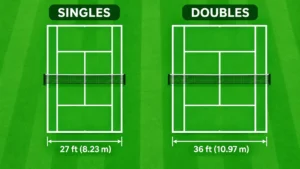
- The same tennis court is used for both singles and doubles games. However, the boundaries of the games are different.
- The width of a singles court is 27 feet. The narrow outer sections, called the doubles alleys, are not used in this game.
- The width of a doubles court is 36 feet. Here, the doubles alleys are also part of the game, and two players play on each side.
- Singles sticks are special posts placed beside the net that help maintain the correct position of the net when playing singles on a doubles court.
Net — Height, Position, Size and Rules
The net is positioned right in the middle of the tennis court and divides the entire court into two equal halves. The height of the net at the two posts on either side is 3 feet 6 inches (1.07 meters), but due to its own weight, the middle part sags slightly and comes down to 3 feet (0.914 meters).
During play, players generally desire to hit shots over the middle of the net because the lower height there transmogrifies the risk of the ball hitting the net. During regular play (rallies), if the ball touches the net and falls into the opponent’s court, the game continues as usual.
Anyway, when serving, if the ball touches the net and lands in the correct ‘service box,’ it is called a ‘let,’ and the server gets to serve again without any penalty.
Tennis Court Size and Measurement: Quick Reference
| Feature | Detail / Measurement |
| Court Length | 78 ft (23.77 m) |
| Singles Width | 27 ft (8.23 m) |
| Doubles Width | 36 ft (10.97 m) |
| Service Box | 21 ft deep 13.5 ft wide |
| Net Height (Center) | 3 ft (0.914 m) |
| Net Height (Posts) | 3.5 ft (1.07 m) |
| Main Lines | Baseline, Singles Sideline, Doubles Sideline, Service Line, Center Service Line, Center Mark |
| Main Zones | Defensive Zone, Neutral Zone, Attacking Zone, Finish Zone/ Kill Zone |
Conclusion
If you know the size of a tennis court, it becomes very easy to understand the rules of the game and with regular practice, you’ll learn to recognize the lines on the court and play better.
FAQ
Length and width of a tennis court?
Tennis court length is 78 feet (23.77 meters), singles court width is 27 feet and doubles court is 36 feet.
What’s the dissemblance between singles and doubles courts?
The same court is used for both types of games. In singles, the angular outer sections on the sides are out of play, but in doubles, those areas are part of the game.
How many service boxes are there on a tennis court?
There are a total of four service boxes, two on each side of the net, and when serving, the ball must be hit diagonally into the opponent’s correct service box.
What is the height of a tennis court net?
The net is 3 feet (0.914 meters) high in the middle and 3.5 feet (1.07 meters) near the posts. This height is set according to the rules of the game.
Are all tennis court flourishes the same size?
Absolutely, the standard size is the same for hard courts, clay courts, and grass courts, but the ball bounce and players’ action differ depending on the court flourishes.
What is no-man’s land on a tennis court?
The area midway the service line and the baseline is called no-man’s land. If someone stays here for too long can make it hard to handle the ball, so that players need to quickly get to the right position.
Why is learning tennis court lines important?
Each line defines the boundaries of the court, the service area, and valid play areas, so if new players understand the lines well, it becomes much smoother for them to learn the rules and play flawlessly.