
The vocabulary of tennis refers to the terms that are associated with the scores, the rules, the court, the shots, and the style of play in a tennis game. Some of the vocabulary terms used in tennis include ace, deuce, love, fault, let, and tie-break.
Getting familiar with these terms will help the learner understand the game, the rules, and the commentary in the game. The tennis vocabulary words will enable one to play and watch tennis.
Tennis Terms and Definitions: How to Use This Glossary
The tennis glossary for beginners is divided into seven different sections so that you can find the definition you want without wasting time. If you are watching a game, start with scoring terms.
On the other hand, if you are about to play a game, learn court and shot terms first. The section related to the rules contains commonly used calls, whereas the tournament and slang sections include words you will hear in broadcasts.
Tennis Scoring Terms
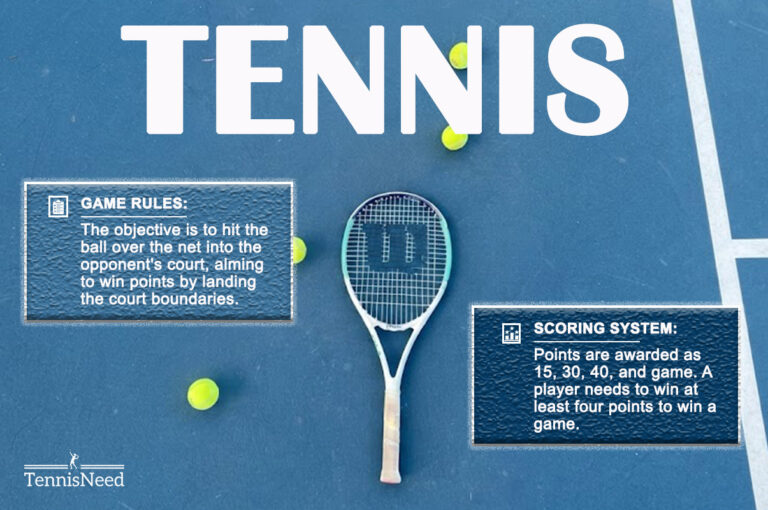
The following tennis scoring terms will deal with points, games, and sets. The explanation provided in our guide on how to keep score in tennis will give you insight into them.
- Love (0): No points at all. Context: This applies to points like “30-love”.
- Fifteen (15): First point earned by any player in a game. Context: Since the server’s score is announced first, “15-0” indicates that the server holds the lead.
- Thirty (30): Second point earned by any player in a game. Context: When both players have earned two points, callers use “thirty-all”.
- Forty (40): Third point earned by any player in a game. Context: Players with forty points just need one additional point to win the game, provided that the opposing players also possess forty points.
- Deuce: A tie score of 40-40 in a game. Background: A term that you get to hear in a tight game, where a player needs to get two consecutive points to win.
- Advantage: The point scored immediately following deuce. Background: The umpire announces “advantage” with the name of the leading player.
- Ad-In: Advantage of the server. Background: The server needs just one point to win the game.
- Ad-Out: Advantage of the receiver. Background: The receiver needs just one point to break serve.
- Game: A basic unit of play in tennis; the winner gets the game by reaching four points with a margin of two points. Background: Scores are calculated in games in a set.
- Set: A series of games, won by the first player who reaches six games with a margin of two games. Background: Best of three or best of five is how the match goes on.
- Match: The whole competition won through the majority of sets. Background: The word “match” is used by announcers to announce the final scores.
- Tiebreak: An unusual game that occurs at 6-6 in the set, which is won when either one of the players wins 7 points with a margin of two points. Context: Helps players avoid endless sets.
- Match Tiebreak / Super Tiebreak: An alternative to a final set that consists of a ten-point tiebreak. Context: Often used in doubles and club matches.
- Straight Sets: A match in which no set has been lost in winning the match. Context: The name that is used in commentaries in matches such as 6-3, 6-4 is called “straight sets.”Context: The one resembles a breadstick, hence the term
- Bagel: A set won 6-0. Context: The zero resembles a bagel, hence the term “serve a bagel.”
- Breadstick: A set won 6-1. Context: This one resembles a breadstick, hence its name.
- Double Bagel: A match in which the score is 6-0, 6-0. Context: This is very rare and tough on beginners and even on professionals.
- Break: Winning a game when the opponent is serving. Context: One break usually determines a set.
- Hold: Winning a game when you are serving. Context: Players “hold their serve” to tie things up.
- Break Point: A point that wins the game for the receiver. Context: Broadcasters show a “break point” graphic during play.
- Set Point: A point that wins the set. Context: Players get nervous on set point.
- Match Point: A point that wins the match. Context: The crowd stands when it comes up.
- Game Point: A point that wins the game. Context: The serving player usually declares it in doubles.
Tennis Court Terms
Court terms in tennis allow players to gain knowledge about court lines, serving lines, and ball positioning. The baseline is the back line at both ends, and this is where the baseliners locate when the rally is going on.
The service line is the line that shows the back end of each service box, and the center service line separates the two service boxes. The center mark is the short line in the middle of the baseline.
Singles Sideline forms the sideline for singles matches. Doubles Sideline is another name for Tramline or Alley, and it helps form the additional width required in doubles games.
A Service Box refers to either of the two areas in which a legal serve must land. Deuce Court refers to the right side of the tennis court when viewed from the position of the serving player.
Ad Court, on the other hand, is the left half of the court. Players serve into the deuce court at the beginning of a game, and the players alternate the service box after each point.
No Man’s Land is also known as the Transition Zone; it is the space between the service line and the baseline, where the players find difficulty reacting.
The net divides the court into two equal parts and is three feet high in the middle. The Net Cord is a strip of tape running across the top of the net.
The Net Post refers to the device used for fixing the net on each side of the court. The Backcourt is the name of the place adjacent to the baseline from where the players mostly play the deep balls and develop their rallies.
Knowledge of the above-mentioned court terms will help the beginner understand instructions and comments related to the position and play in singles and doubles games.
Tennis Shot Terms
Language used to describe shots used in tennis explains how the ball is hit, the direction of the shot, and the playing style against the opponent.
By knowing about the shots in tennis, one can understand the rallies during the game and also the commentaries.
- Serve: The shot used to begin each point in a game. Context: Players alternate serving games during a match.
- Ace: A legal serve that the receiver fails to hit. Context: Commentators consider the number of aces in their analyses of the serving statistics.
- Fault: An improperly delivered serve that does not land in the designated service box. Context: This is followed by the second serve after the first serve fault.
- Double Fault: Two consecutive serve faults that give one point to the receiver. Context: It can result in the player losing an important point from being served.
- Let (Serve): A serve that touches the net but falls within the correct service box and is replayed as per the rules. Context: The player gets a second attempt without the serve being counted as a fault.
- Forehand: A groundstroke that players hit from their dominant hand side. Context: Right-hand players normally hit forehand on their right side.
- Backhand: A stroke played on the other side of the body than where the forehand is played. Usage: The stroke can be played using either one hand or two.
- Volley: A shot played before the ball hits the court. Usage: The player can play the stroke close to the net.
- Half Volley: A stroke played immediately after the ball bounces. Usage: The player can only play the stroke when he fails to play a volley.
- Overhead/Smash: An overhead shot played forcefully when the ball is high. Usage: The player can play the smash against a poor lob.
- Lob: A high stroke that flies above an opponent. Usage: The player plays the lob to pass the ball above an opponent playing at the net.
- Drop Shot: A soft stroke played to barely clear the net. Usage: The stroke can make the opponent move to the front of the court.
- Slice: A stroke played using backspin. Usage: The stroke enables the ball to remain low after bouncing.
- Topspin: Spin that causes the ball to sink into the court and bounce high. Usage: It is a favorite for use in baseline play.
- Flat Shot: A shot that has minimal spin. Context: The players hit this stroke to put the ball in play rapidly.
- Approach Shot: A stroke that is executed with the goal of moving forward to the net. Context: The shot usually comes after a short ball.
- Passing Shot: This is the shot that is made around the opponent player at the net. Context: Players try to hit down-the-line and cross-court passing shots.
- Cross-Court: A shot played diagonally across the court. Context: Players use the diagonal distance to push opponents wide.
- Down the Line: A shot played parallel to the sideline. Context: The shot catches opponents who are approaching the center of the court.
- Winner: This is a shot that allows the winner to score a point because the opponent is unable to return it effectively. Explanation: Winner shots can be achieved from serves, ground strokes, volleys, and smashes.
- Unforced Error: This is an error that is made by a player without being pressured by the player’s opponent.
- Forced Error: An error committed by a player due to the opponent’s speed, placement, spin, or pressure. Context: A tough defensive shot may force players to hit wide or into the net.
Tennis Rule Terms
Tennis rules terminology helps the players comprehend the official calls, penalties, and procedures. A Foot Fault is committed by the server if he breaches the foot-positioning rule during his serve; the tennis serve rules guide elaborates on this.
The Let (General) is an instance where play is halted, and the point or serve is to be repeated if the particular rule dictates that.
Hindrance means an action or noise made by one player which distracts the opponent. In means the ball lands on or inside the line, while Out means it is on the other side of the boundary line.
A Challenge means a request for a review of the line call; Hawkeye keeps a record of the ball placement, and the Electronic Line Calling System automatically makes the line calls.
A Changeover is the interval in which players change ends as per the rules of the competition. Retirement refers to the event where a competitor withdraws from competition before the end of the game due to injury or sickness.
A Walkover is when a competitor is promoted due to the inability of the opposing party to compete in the game. A Default means the removal of a competitor from the game due to a violation of the competition’s rules.
A Code Violation is a punishment for misconduct against the rules of competition, whereas a Time Violation refers to a delay beyond the allotted time limit between two consecutive points and other timed activities.
Tennis Match and Tournament Terms
In tennis tournament terminology, much can be learned about the way in which players qualify for the tournament, get ranked, and play in the tournament. Grand Slam is the name of one of the four tournaments that take place, namely the Australian Open, French Open, Wimbledon, and US Open.
The top tour for men professionals is managed by ATP, and the women’s professionals are managed by WTA. ITF is responsible for international tennis and running events like national team events.
The Wildcard provides an exceptional qualification for a player who does not have direct qualification, whereas the Qualifier gets qualification for the main draw through the qualifying rounds.
The Lucky Loser gets into the main draw after losing in the qualifying round finals, often due to the withdrawal of another player. The Draw provides information on the matches and a player’s path within the tournament.
A Round Robin is the name of the format where players compete against several opponents at once in a group. The Davis Cup is an international team competition among men, and the Billie Jean King Cup is its female version.
Best of 3 is a rule that applies when the first person to win two sets wins the match; Best of 5 means that three sets should be won. A Deciding Set is the last set determining the winner when others have been tied.
Tennis Player Type Terms
The player types in tennis indicate playing styles and tactics rather than categories of players. The Baseliner wins most of his points through staying near the baseline employing his ground strokes, consistency, and positioning.
The Serve and Volleyer executes his serve and charges towards the net to win the point through the volley stroke. The All-Court Player plays according to the match circumstances, either at the net or baseline.
A Pusher is the nickname given to players who are always looking to hit back shots and generate errors rather than hitting winners. A Big Hitter tries to generate pressure and take away the time of his opponents through powerful groundstrokes and attacking strokes.
A Counter-Puncher is a type of player who thrives on absorbing pressure and playing on the opponent’s weaknesses, often excelling in long rallies. A Moonballer plays high looped balls, usually with topspin.
Tennis Slang and Informal Terms
The slang used for tennis brings out a unique character in discussions, coaching, and even commentary of matches. A Bagel is an expression for winning a set 6–0, while a Breadstick is another name for a 6–1 set; this refers to the shapes associated with the numbers.
A Double Bagel refers to winning 6–0, 6–0 in a best-of-three matches. The Tank term is used to refer to intentionally bad performance. The Shank is a poor shot where the ball hits the racquet frame rather than the strings.
Chip and Charge is a maneuver of striking a low, controlled return shot and then running up the net. The T-Serve is a serve aimed at the middle of the service box, while the Body Serve is directed at the opponent’s body and the Wide Serve targets the side of the box.
Golden Set is a set won without losing even a single point and thus is considered a very rare feat. Tweener is the name given to a shot played between the legs and often when one tries to catch the lob.
Hot Dog is a slang term referring to the flashy shot that may include either the legs or behind the back; it’s used inconsistently. SABR stands for “Sneak Attack By Roger” and refers to the tactic used by Roger Federer of moving forward to attack the serve.
Commonly Confused Tennis Terms
These tennis terms and definitions trip up new fans.
Fault vs Let
|
Fault |
Let |
|
A failed serve: in the net, outside the box, or a foot fault. |
A serve that clips the net and lands in. The server replays it with no fault. |
Ad-In vs Ad-Out
|
Ad-In |
Ad-Out |
|
The server has the advantage after deuce. |
The receiver has the advantage after deuce. |
Deuce Court vs Ad Court
|
Deuce Court |
Ad Court |
|
The right half, from the server’s view. |
The left half, from the server’s view. |
Forced Error vs Unforced Error
|
Forced Error |
Unforced Error |
|
The opponent’s pressure caused the miss. |
The player missed an easy shot alone. |
Winner vs Ace
|
Winner |
Ace |
|
Any shot the opponent cannot reach. |
A serve the receiver never touches. Every ace is a winner, but not every winner is an ace. |
Frequently Asked Questions About Tennis Terms
1. Why does tennis use “love” instead of zero?
The most common theory traces the “love” to the French l’oeuf, which stands for egg, as an egg looks like a zero. Still, no historian has confirmed this theory as the ultimate truth behind the origin of the term.
2. Why does tennis scoring go 15, 30, 40 instead of 1, 2, 3?
One of the theories attributes the origin of the scoring system to a clock face where points move in quarter-turns from 15 to 30 to 45. Why not 45, but 40 is used in tennis remains unknown. The clock theory has not been proven yet.
3. What is the difference between a fault and a let in tennis?
A fault means an unsuccessful serve; a let serve should be played again if the ball touched the net cord and landed in a proper service box. A foot fault is also regarded as a service fault.
4. What is the difference between ad-in and ad-out?
Ad-in means that the server has the advantage after deuce, while ad-out means that the receiver has the advantage. The next point will decide the game or bring the score back to deuce.
5. What does “ace” mean in tennis?
An ace is a legal serve that the opponent fails to reach, which results in the immediate winning of the point by the server.
6. What is a bagel in tennis?
A bagel is the situation where the set is won with a score of 6-0; that is, the other player doesn’t win any games during the set. A double bagel is the score of 6-0, 6-0 in a best-of-three-sets game.
7. What does “break” mean in tennis?
A break refers to winning the game by the receiving player from the server, and holding the serve is winning the game by yourself from the service position.
8. What is a pusher in tennis?
A pusher is a type of player whose strength lies in consistency and hitting more balls back to the opponent rather than attacking. This is just an informal way of labeling such players.
9. What is a moonball in tennis?
A moonball is a very high shot that uses lots of topspin and also bounces very far behind the court. It is used by players to disrupt their opponent’s style of play, which involves quick and low shots.
10. What does “Grand Slam” mean in tennis?
It applies to the Australian Open, French Open, Wimbledon, and US Open tournaments. To win all four tournaments in one calendar year is termed a Calendar Grand Slam.
11. What is Hawkeye in tennis?
Hawkeye is a technology for tracking the ball that traces its trajectory in order to determine its landing point. Electronic line calling involves making automated decisions based on this technology without depending on player challenges.
12. What is a wildcard in tennis?
A wild card is a special entry to a tournament that is given to a player who does not qualify for the event using regular entry criteria. The tournament organizer may give the entry to a talented player or a returning player, among others.
13. What is a tweener in tennis?
A tweener is a shot that a player takes when he is between his legs after running away from the net in an attempt to reach a lob shot.
14. What does “no man’s land” mean in tennis?
No man’s land refers to the space lying between the service line and the baseline. It is challenging for players to defend this region since they might have trouble with both deep groundstrokes and strokes aimed at the net.
15. What is a break point in tennis?
A break point arises when the receiver only needs one point more than the server to win the game. It could shift the dynamics of the set when scored.
16. What is the difference between a winner and an ace?
A winner refers to any stroke that an opponent is unable to return. An ace is a specific kind of point-winning stroke in which the receiver fails to return it.
17. What is an unforced error in tennis?
An unforced error refers to errors committed without much pressure from an opponent. These errors include hitting an easy shot into the net or long on a comfortable ball.
18. What does “love” mean in a score such as 30-love?
Love equals zero, and the score of the server is said first. It therefore implies that 30-love means the server has 30 points while the receiver has zero points.
19. What is a code violation in tennis?
A code violation refers to any conduct that breaches the rules of the competition, for instance, racket abuse and verbal abuse. As per the violation and the rules, the punishment may increase from a warning to point penalties, game penalties, or disqualification.
20. What is a lucky loser in tennis?
A lucky loser refers to the player who does not qualify for the competition after the final qualification game but gets into the main event because another player has pulled out of the event.
If you want to understand how points become games and sets, continue with the guide to how to keep score in tennis or explore the Tennis Basics hub.
These resources build on the tennis terms and definitions covered here and help you follow a match with greater confidence.
Conclusion
Knowledge of tennis terminology and definitions is crucial for newcomers in order to understand the matches, learn the rules of the game and feel comfortable while communicating during tennis games.
Every tennis term describes some element or aspect of the sport. This glossary is intended to serve as a fast reference source during watching or playing tennis matches.
You may refer to our guides concerning the tennis scoring system and basic rules of tennis for more information.