

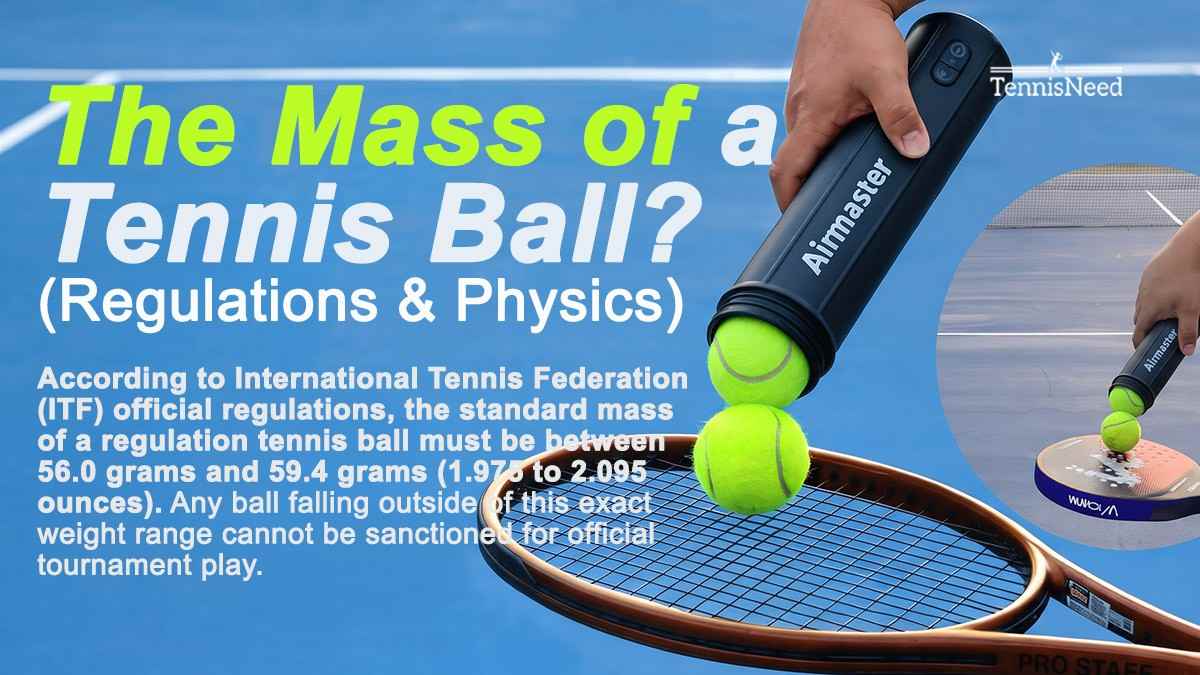
According to the International Tennis Federation (ITF) official regulations, the standard mass of a regulation tennis ball must be between 56.0 grams and 59.4 grams (1.975 to 2.095 ounces).
Any ball falling outside of this exact weight range cannot be sanctioned for official tournament play.
Tennis is one of the most widely played sports in the world, and every component of the game is governed by precise physics. The tennis ball is perhaps the most engineered piece of equipment on the court.
Understanding the mass and volume of a tennis ball explains why balls bounce, travel, and spin the way they do during high-intensity rallies.
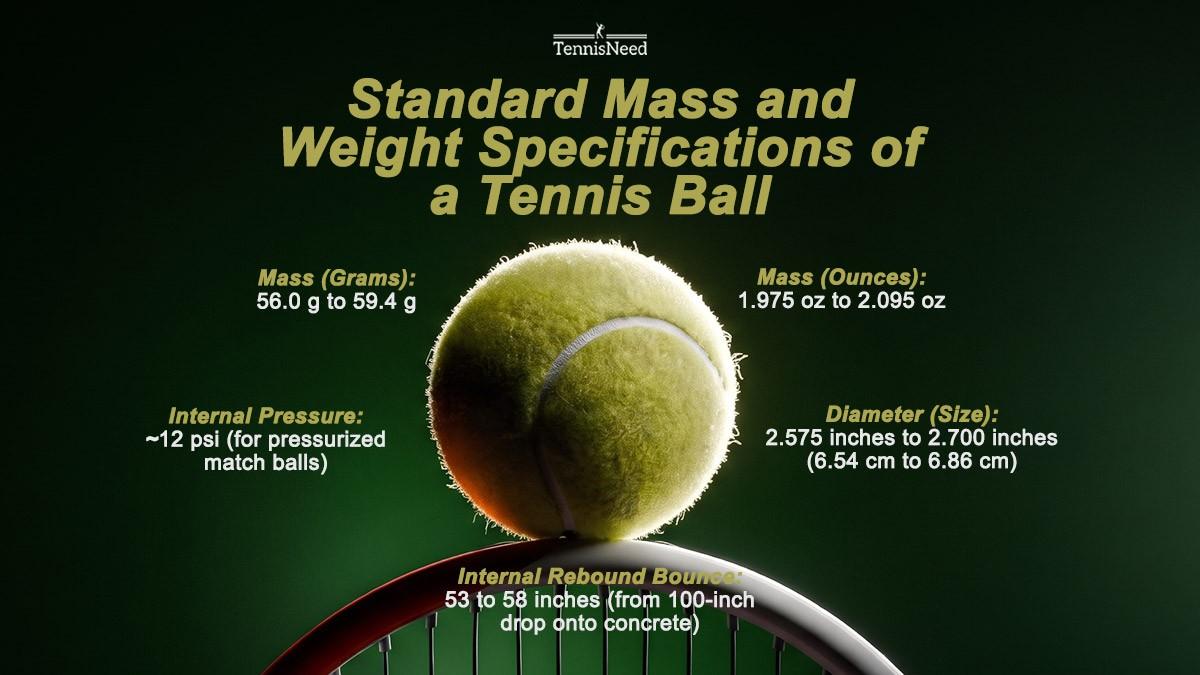
Standard Mass and Weight Specifications of a Tennis Ball
The ITF categorizes balls into three primary types for tournament play (Type 1 Fast, Type 2 Medium, and Type 3 Slow). However, regardless of whether the ball is designed for fast grass courts or slower clay surfaces, the standard mass range remains the same:
For more detailed sizing measurements, see our guide on how big a tennis ball is in inches and centimeters.
| Specification Property | Standard Measurement |
|---|---|
| Mass (Grams) | 56.0 g to 59.4 g |
| Mass (Ounces) | 1.975 oz to 2.095 oz |
| Diameter (Size) | 2.575 inches to 2.700 inches (6.54 cm to 6.86 cm) |
| Internal Rebound Bounce | 53 to 58 inches (from 100-inch drop onto concrete) |
| Internal Pressure | ~12 psi (for pressurized match balls) |
Why Does Ball Mass Matter in Tennis Physics?
In physics, momentum is defined as mass multiplied by velocity ((p = mv)). When a professional player hits a 130 mph (209 km/h) serve, the mass of the tennis ball contributes to its momentum and kinetic energy, influencing the impact between the ball and racquet strings.
- Racquet Shock and Arm Comfort: Ball mass is one of several factors influencing impact forces transmitted through the racquet and the player’s arm. Racquet characteristics, swing speed, string tension, and hitting technique also affect impact comfort. If you experience elbow discomfort, read our recovery guide on where to put TENS pads for tennis elbow.
- Aerodynamic Drag and Air Resistance: The fuzzy felt cover on the ball affects airflow and creates aerodynamic drag, slowing the ball during flight. To explore why felt exists, check out our article on why tennis balls have fuzz.
- Topspin and the Magnus Effect: When a player brushes the racquet against the ball, friction creates rotational motion. This topspin interacts with airflow and produces the Magnus effect, helping the ball dip toward the court.
Pressurized vs. Pressureless Tennis Balls: Does Mass Differ?
While both pressurized and pressureless tennis balls can meet the standard mass range of 56.0–59.4 grams, their internal construction differs substantially.
- Pressurized Balls: These balls contain gas pressure inside their hollow rubber cores. They generally feel livelier off the racquet but gradually lose internal pressure through the rubber over time.
- Pressureless Balls: These balls rely primarily on the elasticity of their rubber cores rather than internal gas pressure to generate bounce. They generally maintain their playing characteristics for longer periods. Explore our recommendations for pressureless practice balls and pressureless balls for tennis ball machines.
How Much Does a Tennis Ball Weigh in kg?
A standard tennis ball weighs between 0.0560 and 0.0594 kilograms (56.0–59.4 grams). According to the International Tennis Federation (ITF), this is the regulation mass range for standard tennis balls.
The midpoint of this range is approximately 0.0577 kg (57.7 grams). Although this difference may seem small, a tennis ball’s mass contributes to its movement, bounce, and overall performance during a match.
Whether you are a beginner, recreational player, or professional tennis enthusiast, understanding the standard mass of a tennis ball can help you understand the equipment used in the sport.
What Is the Standard Weight of a Tennis Ball?
The official mass of a standard tennis ball is regulated by the International Tennis Federation (ITF). According to ITF tennis ball specifications, an approved standard tennis ball must weigh between 56.0 and 59.4 grams.
Here is a quick breakdown:
| Measurement | Weight |
|---|---|
| Minimum weight | 56.7 grams |
| Maximum weight | 58.5 grams |
| Minimum weight in kg | 0.0567 kg |
| Maximum weight in kg | 0.0585 kg |
| Average weight | 57.6 grams |
| Average weight in kg | 0.0576 kg |
These standards help ensure consistency in tennis ball performance across different tournaments and playing conditions.
How Much Does a Tennis Ball Weigh in Grams?
A standard tennis ball weighs between 56.0 and 59.4 grams. However, the exact mass depends on the individual ball and its manufacturing specifications.
For example:
- A tennis ball weighing 56.0 grams is at the minimum permitted limit.
- A tennis ball weighing approximately 57.7 grams is near the midpoint of the regulation range.
- A tennis ball weighing 59.4 grams is at the maximum permitted limit.
- All three measurements fall within the standard ITF mass range.
What Is the Mass of a Tennis Ball in Ounces and Pounds?
The mass of a regulation tennis ball ranges from approximately 1.975 to 2.095 ounces, or 0.1234 to 0.1309 pounds.
Here is a conversion table:
| Measurement | Minimum | Maximum |
| Grams | 56.0 g | 59.4 g |
| Kilograms | 0.0560 kg | 0.0594 kg |
| Ounces | 1.975 oz | 2.095 oz |
| Pounds | 0.1234 lb | 0.1309 lb |
These conversions make it easier to understand tennis ball mass regardless of which measurement system you use.
Why Does Tennis Ball Weight Matter?
A tennis ball’s mass contributes to how it behaves during a match. Its interaction with racquet strings, court surfaces, and airflow influences its overall playing characteristics.
The ball’s speed, spin, rubber elasticity, felt covering, and internal pressure also affect its performance. Therefore, mass is important, but it is not the only factor determining how a tennis ball moves and bounces.
Do All Tennis Balls Weigh the Same?
No. Not all tennis balls have exactly the same mass.
Different manufacturers produce tennis balls with slightly different masses, but approved standard tennis balls must stay within the ITF regulation range of 56.0–59.4 grams.
There are also different types of tennis balls:
- Regular-duty tennis balls: Designed mainly for softer indoor courts and clay courts.
- Extra-duty tennis balls: Designed for harder court surfaces.
- Pressureless tennis balls: Designed to maintain their playing characteristics over extended use.
- Low-compression tennis balls: Designed for beginners and junior players.
Does Tennis Ball Weight Vary by Manufacturer or Type?
Yes. The actual mass of an individual tennis ball can vary slightly depending on its manufacturer, model, materials, and production tolerances. However, standard tennis balls intended for regulation play must meet the ITF mass specifications.
Different tennis ball types can also have different physical characteristics:
- Regular-duty balls: Have a felt covering designed for particular court surfaces.
- Extra-duty balls: Use a more durable felt covering for hard-court play.
- Pressureless balls: Use a different internal construction to generate bounce without relying on conventional internal gas pressure.
- Low-compression balls: Are designed to reduce ball speed and make learning tennis easier.
The distinction is that ball construction and playing characteristics can change without changing the official mass range for standard regulation tennis balls.
What Are Tennis Balls Made Of and How Does Their Construction Affect Mass?
A modern tennis ball generally consists of a hollow rubber core covered with a fibrous felt material. The rubber core provides elasticity, while the felt covering influences its aerodynamic properties and interaction with the court surface.
Its main components include:
- Natural and synthetic rubber: Used in the rubber core to provide elasticity and rebound.
- Felt covering: Usually made from a textile blend, including wool and nylon, depending on the manufacturer.
- Adhesive: Helps attach the felt covering to the rubber core.
The combined mass of these materials determines the finished ball’s mass. Manufacturers must ensure that regulation tennis balls meet the applicable ITF specifications.
How Much Would 12 Tennis Balls Weigh?
Twelve standard tennis balls would have a combined mass of approximately 672–712.8 grams, excluding packaging.
The calculation is:
- Minimum: 12 × 56.0 = 672 grams.
- Maximum: 12 × 59.4 = 712.8 grams.
This means a dozen regulation tennis balls would have a combined mass of approximately 0.672–0.713 kilograms before adding a can or other packaging.
What’s Heavier, a Golf Ball or a Tennis Ball?
A standard tennis ball is heavier than a regulation golf ball.
A regulation tennis ball has a mass of 56.0–59.4 grams, whereas a golf ball must not exceed 45.93 grams under golf equipment regulations.
| Ball Type | Mass |
| Tennis ball | 56.0–59.4 g |
| Golf ball | Maximum 45.93 g |
Therefore, even the lightest regulation tennis ball is heavier than a golf ball at its maximum permitted mass.
Frequently Asked Questions (FAQ)
What is the mass of a tennis ball in grams?
A standard tennis ball has a mass between 56.0 grams and 59.4 grams according to International Tennis Federation (ITF) specifications.
What is the mass of a tennis ball in kg (kilograms)?
In kilograms, the mass of a standard tennis ball ranges from approximately 0.0560 kg to 0.0594 kg. The midpoint of this range is approximately 0.0577 kg.
How much does a can of 3 tennis balls weigh?
A sealed can containing three tennis balls weighs more than the balls alone because it includes the packaging. The three balls have a combined mass of approximately 168–178.2 grams. The final packaged mass depends on the can and its material.
Why do tennis balls lose bounce over time?
Standard pressurized match balls contain gas that gradually permeates through the rubber shell. Over time, internal pressure drops, causing the ball to feel less lively and bounce lower. Repeated impacts and felt wear can also affect its playing characteristics.
What Is the Mass of a Wilson Tennis Ball?
The mass of a Wilson tennis ball depends on its model and specifications. Regulation Wilson tennis balls intended for standard play must comply with the ITF mass range of 56.0–59.4 grams. For an exact model-specific measurement, check the manufacturer’s product specifications or weigh an individual ball.
Which Has More Mass, a Bowling Ball or a Tennis Ball?
A bowling ball has considerably more mass than a tennis ball. Standard bowling balls generally weigh between 6 and 16 pounds (approximately 2.72–7.26 kilograms), while a regulation tennis ball weighs just 56.0–59.4 grams.
Does the Mass of a Ball Affect How Far It Rolls?
Yes, mass can influence how a ball moves, but rolling distance also depends on its speed, surface friction, deformation, air resistance, and other physical properties. For tennis balls, the rubber core, felt covering, and court surface all influence movement.
Do Pressureless Tennis Balls Have the Same Mass as Pressurized Balls?
Both types of tennis balls can meet the standard ITF mass range of 56.0–59.4 grams. However, their internal construction differs. Pressurized balls rely on internal gas pressure, while pressureless balls primarily generate bounce through the elasticity of their rubber core.